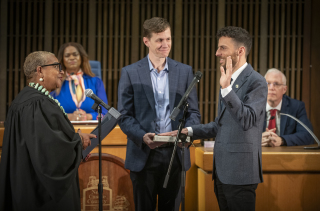
On November 17, 2026, newly elected New Castle County Councilmember Jason Hoover took his oath of office on Braiding Sweetgrass, a book written by Dr. Robin Wall Kimmerer, a botanist who brings together Indigenous teachings and scientific knowledge about our relationship with the natural world.
The choice was intentional. Rather than using a traditional religious text, Hoover chose a book whose teachings reflect the philosophy he hopes to bring to government: that our communities are built on relationships, and that we have responsibilities to the people, places, and natural systems that sustain us.
A scientist by training, an avid trail runner, and a longtime conservation advocate, Hoover sees the natural world as a model for understanding the communities we live in.
"A forest isn't just a collection of trees. It's a collection of relationships. And our communities work much the same way. A community isn't just a collection of people. It's a collection of relationships."
At the center of this philosophy is reciprocity: the understanding that we benefit from our relationships with others and have responsibilities in return.
For Hoover, that principle has practical implications for government. Decisions about housing, development, infrastructure, and public spaces have consequences that extend far beyond their immediate purpose. Recognizing those relationships means considering not only the benefits of a decision, but also who bears its costs and how it affects the community as a whole.
"Just because we fail to recognize a relationship doesn't mean that relationship goes away," Hoover said.
Hoover's perspective is informed by years of community organizing and environmental advocacy. He founded Save the Valley, a grassroots conservation organization that worked alongside other partners to protect Beaver Valley from development. The preservation effort ultimately helped bring the land into First State National Historical Park.
That experience reinforced his belief that caring for the natural world and building strong communities aren't separate goals. Both require recognizing the relationships that make a place valuable, including the ones that don't always appear in traditional economic measurements.
Hoover also emphasized that these principles must extend to the way elected officials work together.
In his remarks to his twelve fellow councilmembers, he committed to approaching disagreements with kindness, respect, and a genuine effort to understand others' perspectives.
"We don't need to agree to have a good relationship. But we do need to make the effort to understand one another."
By choosing Braiding Sweetgrass for his oath, Hoover sought to make those commitments visible from his first day in office: to recognize our interconnectedness, to take responsibility for the consequences of public decisions, and to help build communities where people and the natural world can thrive.
Resources