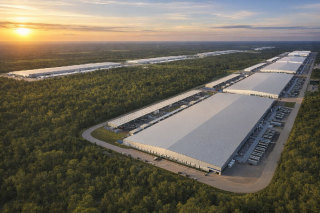
As things stand today, data centers are a bad deal for Delaware.
That's not because I'm opposed to technology. It's not because I'm opposed to economic development. And it's certainly isn't because I don't want good jobs.
It's because the current deal asks Delaware families to take on enormous costs while receiving very little in return.
We're taking the risks, but we're not getting the rewards.
That's why I support a moratorium on new data centers until our county and state laws catch up.
One of the biggest arguments in favor of data centers is that Northern Virginia has generated enormous tax revenue from them.
That's true.
But Delaware's tax laws are completely different.
A large data center campus in Loudoun County, Virginia can generate an estimated $205-$263 million every year in local tax revenue.
The same campus in New Castle County would likely generate only $2-$5 million per year.
Why? Because Virginia taxes the billions of dollars of servers and computer equipment inside the building. Delaware doesn't. We can only tax the building itself.
Think about buying a new refrigerator. Virginia taxes the refrigerator. Delaware taxes the cardboard box it came in.
We're taking the risks, but we're not getting the rewards.
Data centers consume enormous amounts of electricity.
Project Washington alone is expected to require roughly the same amount of electricity as Delaware's existing demand.
That kind of growth doesn't happen for free. It requires new transmission lines, substations, and electrical infrastructure. Someone has to pay for it.
The question is simple: Should Delaware families subsidize billion-dollar corporations through their monthly electric bills?
I don't think they should.
If a company creates the costs, the company should pay the costs.
The Delaware Public Service Commission has already studied scenarios involving projects of this scale and found significant risks to energy costs and grid reliability if these loads are added without the right protections, including estimates showing electric costs could increase by about 9% with one Project Washington-sized data center and up to 82% with two.
We're taking the risks, but we're not getting the rewards.

Until this year, New Castle County didn't even have data center regulations. The category flat out didn't exist in our county zoning code.
The first ordinance established common-sense protections like:
Noise limits
Those are good protections. I supported them. But they don't solve the biggest issues.
They don't determine:
Those questions are still being debated today. That's why approving projects before those laws are in place simply doesn't make sense.
They are not an ongoing industry so much as a construction project. During the build, they can create hundreds or even thousands of temporary jobs. But once construction ends, those jobs largely disappear.
After completion, data centers typically operate with only a few dozen permanent employees, despite their massive size, energy use, and infrastructure demands.
In the long run, the costs outweigh the benefits.
No.
This is one of the biggest myths surrounding this issue.
While Delaware is part of the PJM regional electric grid, location still matters. A data center built in Delaware creates Delaware electric demand. That affects local transmission planning, congestion, infrastructure upgrades, and electric costs differently than a data center built in another state.
Building the same facility elsewhere in PJM does not create the same impacts here. That's why utilities and regulators study where these facilities are built, not just how much electricity they use.
Because our tax laws are different. Virginia taxes the servers and computer equipment inside data centers. Delaware doesn't.
Most of the revenue that makes data centers so profitable for Virginia simply doesn't exist under Delaware law.
Somewhat. New Castle County recently passed its first data center regulations.
Those rules address issues like noise, setbacks, cooling systems, and decommissioning. They do not address many of the biggest financial questions surrounding electricity, tax policy, and ratepayer protection. Those conversations are still happening at the state level.
Because our laws haven't caught up. I'm not calling for a permanent ban on data centers.
I'm saying Delaware shouldn't approve projects of this scale until we know:
That's just common sense.
I'm proud to be the only candidate in this race calling for a moratorium until Delaware has the laws in place to protect its residents.
I'm also proud that I refuse corporate and developer money, so my decisions aren't influenced by the interests seeking these approvals.
My opponent opposed the only data center regulations New Castle County has ever passed.
I supported them.
Because I believe our first responsibility is to the people who already live here.
If Delaware is going to host some of the largest electrical loads in the country, then Delaware residents deserve more than promises. They deserve protections. They deserve transparency. And they deserve a deal that's actually worth making.
Until then, data centers are a bad deal for Delaware.