Delaware recently announced nearly $10 million in new funding for affordable housing. That money will help repair homes, build units, and support people who need housing right now. That matters.
But it also raises a deeper question that rarely gets asked.
Why is housing so expensive in the first place?
The answer is not just about supply or demand. It is about how we have structured the economics of development, and who is allowed to pass their real costs onto everyone else.
To understand the problem, it helps to run a simple thought experiment.
They are responsible for everything. Roads. Sewers. Water lines. Emergency services. Snow plowing. Maintenance. Not just at the beginning, but forever.
What would they build?
They would not build spread-out subdivisions with long roads and scattered homes. That would be an inefficient use of land and infrastructure. Every additional foot of road and pipe would cost them money, year after year.
They would build denser, more walkable neighborhoods.
Not because they are idealistic. Because it is cheaper, more efficient, and more profitable when you are paying the full cost yourself. You get more homes per acre, more value per foot of infrastructure, and far lower long-term expenses.
In a true free-market environment, density wins.
But that is not the system we have.
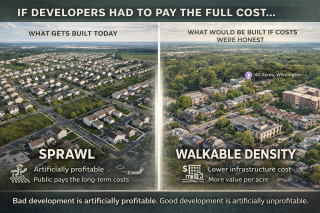
Left: This is what developers build when costs are offloaded onto everyone else.
Right: This is what they’d build if they had to pay the true cost.
We’ve made good development illegal and bad development artificially profitable.
In our current system, developers do not pay the full cost of what they build. A large portion of the expense is shifted onto the public. Roads are maintained by the county and the state. Utilities are extended with public money. Fire, police, and emergency services are absorbed into shared budgets.
These are what I call forever costs. They do not disappear once the homes are sold. They last for decades.
When the tax revenue from a sprawling development does not cover those costs, the shortfall does not come from the developer. It comes from everyone else.
Residents in older neighborhoods. People living in more compact, efficient communities. City taxpayers whose neighborhoods generate far more value per acre than they consume.
That is the hidden subsidy.
Sprawl is not profitable because it is efficient. It is profitable because part of the bill is being paid by someone else.
That is why bad development is artificially profitable.
And it is also why good development is artificially unprofitable.
Walkable, mixed-income neighborhoods cost less to serve and generate more long-term value. But zoning rules, parking requirements, and land use restrictions make them difficult or impossible to build in most places. The most fiscally responsible kind of housing is often illegal, buried in red tape, or financially punished.
So when we celebrate affordable housing grants, we should also be honest about what they represent.
We are spending public money to make housing affordable because we have rigged the system to make affordability nearly impossible without subsidies.
That does not mean the funding is wrong. It means it is incomplete.
We cannot subsidize our way out of a structural problem.
If we want more affordable housing, we have to stop rigging the economics against it. We have to stop making sprawl artificially profitable and walkable communities artificially unprofitable.
That is what I mean by repricing for reality.
When development is priced honestly, when projects account for their real costs, the incentives flip. Developers do not need to be forced to build better places. They naturally choose them.
We do not need to fight the market. We just need to fix the math.