

And why it has more to do with infrastructure than how much energy you use
If your utility bill in Delaware has gone up recently, you are not imagining it. And it is not just because energy suddenly became more expensive.
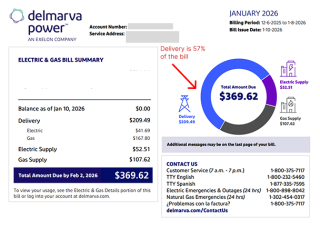
In fact, recent bills explicitly note that Delivery System Improvement Charges (DSIC) increased effective January 1, 2026 . That line item is a big part of why many households are seeing higher costs, even if their usage has not changed.
To understand why, it helps to look at how utility bills actually work.
Every utility bill has two main components.
The first is supply . That is the electricity or gas you actually use.
The second is delivery . Delivery covers everything required to get that energy to your home, including pipes, wires, maintenance, repairs, and long-term system upgrades.
Most people focus on supply. But delivery is where many of the recent increases are coming from.
Delivery costs are not driven by how many customers a utility serves. They are driven by how much infrastructure the utility has to build, maintain, and eventually replace.
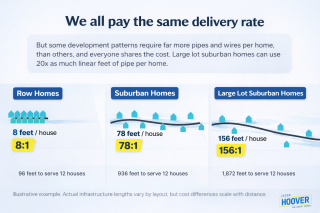
The farther apart homes are, the more pipe and wire is required per household. Over time, that infrastructure becomes more expensive to maintain and more expensive to replace.
Utilities recover those costs through delivery charges, including mechanisms like DSIC , which allow companies to spread infrastructure costs across their entire customer base.
In Delaware, many customers served by Delmarva Power have seen delivery charges increase as infrastructure replacement programs expand. Delmarva Power is owned by Exelon , the same parent company that owns PECO in Pennsylvania.
DSIC charges are designed to fund long-term system upgrades. But what often gets overlooked is why those upgrades are so costly in the first place.
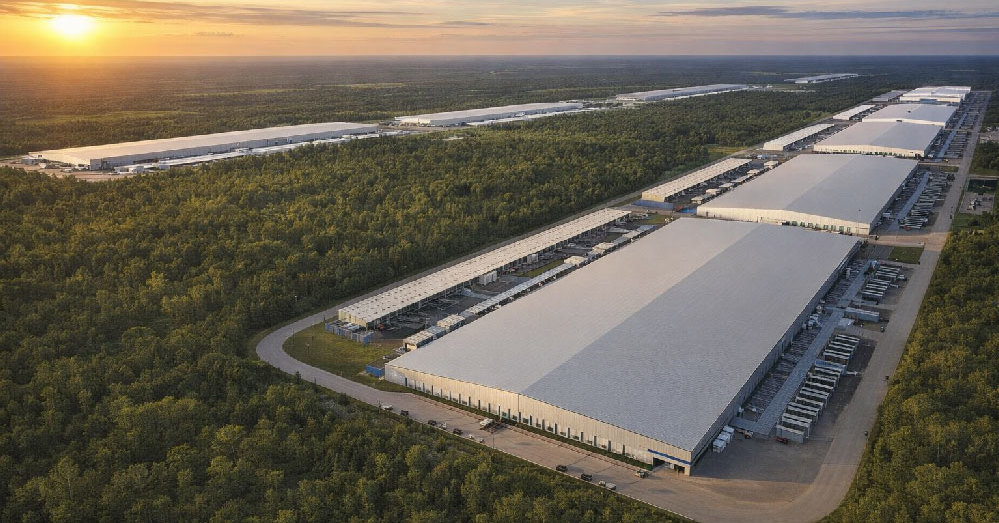
Low-density, spread-out development requires significantly more infrastructure per household. Once that infrastructure exists, utilities are obligated to maintain and replace it. Those costs do not stay isolated. They are spread across everyone who pays a bill.
Here is the part most people are not told.
When we build farther and farther apart, delivery costs rise system-wide. Even if your personal energy usage stays the same, your bill can go up because the underlying network is becoming more expensive to maintain.
This is why delivery charges now make up a large share of many gas and electric bills, especially in winter. Much of the increase is tied to infrastructure replacement and cost recovery, not individual consumption.
This is not an accident. It is the result of long-term development patterns.
For decades, we have allowed growth that requires large amounts of infrastructure per household. Those patterns do not pay their own long-term costs. Instead, the costs show up later on utility bills, tax bills, and the overall cost of living.
When I talk about repricing reality , this is exactly what I mean.
Bad development is not inevitable. It only exists because we subsidize it and hide its true costs. Walkable, compact, community-centered neighborhoods cost less to serve and generate more value over time.
If we price development honestly by aligning our laws and incentives with real infrastructure costs, the market responds. Development shifts toward places that are more efficient, more affordable, and less expensive to maintain.
When growth pays its own way, fewer costs get pushed onto working families. Utility bills stabilize. Public services become easier to fund. Communities become stronger.
That is how we fix the math.