

Why New Castle County Can’t Afford Its Own Zoning Map

What the Zoning Map Actually Allows

A quantitative look at development, land use, and fiscal outcomes in New Castle County

For years, conversations about growth, taxes, infrastructure, and affordability in New Castle County have circled the same frustrations. Costs rise faster than revenues. Roads, pipes, and public services strain under maintenance backlogs. Housing becomes harder for young people to afford. New development is often blamed, even as the county continues to grow.

This article takes a step back from opinion and looks at the numbers beneath the debate .

Specifically: What does New Castle County’s zoning map actually allow us to build, and what does that imply for long-term fiscal health?

This is not a moral argument or a design critique. It is an attempt to measure how much land is legally reserved for different development patterns, and how those patterns tend to perform fiscally over time.

The conclusion is difficult to avoid: one of the biggest barriers to building smarter is simply making it legal to do so.

How this analysis was done

Using publicly available zoning data from New Castle County’s GIS system, we calculated the total acreage assigned to each zoning category. Each zoning district was then grouped based on well-established fiscal performance patterns observed across the U.S.:

  • How much development typically fits on an acre
  • How much infrastructure that development requires
  • How much tax revenue that acre tends to generate
  • Whether revenues tend to exceed long-term public costs

This approach is commonly used in municipal finance analysis. It does not calculate parcel-level profits or losses, and it does not assume every project behaves identically. Instead, it evaluates patterns , not individual outcomes.

There is some unavoidable judgment involved in grouping districts. Boundaries between categories are not perfectly sharp, and small classification changes can move acreage slightly between groups. For that reason, this article focuses on orders of magnitude and proportions , not precise acre counts carried out to the last digit.

The results are consistent across reasonable interpretations.

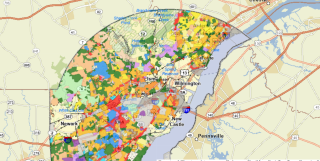
Caption: NCC is freckled with different types of zoning categories. Each zoning category holds a different economic potential.

Three fiscal outcomes of residential zoning

For the purposes of this analysis, residential zoning districts were grouped into three broad fiscal categories.

Fiscally productive

These districts are compact enough that, on average, they generate more public revenue per acre than they cost to serve over time. They use infrastructure efficiently and tend to stabilize municipal budgets.

This category includes:

  • Smaller-lot single-family zoning
  • Townhouses
  • Apartments and multifamily
  • Some compact planned developments

Fiscally fragile

These districts often appear reasonable and familiar, but frequently struggle to fully cover long-term infrastructure and service costs unless conditions are ideal.

They can function in the short term, but tend to accumulate maintenance liabilities over decades.

This category includes:

  • Medium-lot suburban zoning
  • Low-to-moderate density residential districts

Fiscally destructive

These districts are consistently associated with high public costs and low revenue per acre. Over time, they rely on subsidy from more productive areas.

This category includes:

  • Large-lot residential
  • Estate and exurban zoning
  • Very low-density suburban forms

These labels describe financial performance , not neighborhood quality or intent.

What the zoning map shows

When residential zoning acreage is grouped this way, a clear pattern emerges.

  • Only a relatively small share of residential land is zoned for consistently productive development.
  • A large majority of residential land falls into the fiscally fragile middle.
  • A meaningful portion is zoned for patterns that are structurally costly over time.

Depending on how borderline categories are treated, the exact percentages shift modestly. But across all reasonable interpretations:

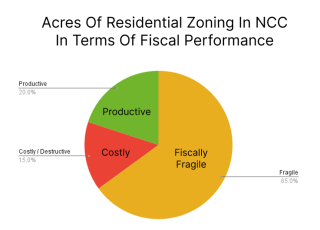
  • Roughly two-thirds of residential land is zoned in a way that is fiscally fragile.
  • Less than one-quarter is clearly zoned for fiscally productive residential patterns.
  • The remainder is zoned for development that almost never pays for itself.

These proportions matter far more than the exact numbers.

Caption: In New Castle County, only a small share of residential zoning reliably pays for itself, most of it sits in a fiscally fragile middle, and a meaningful portion is structurally subsidized by the rest.

Why the “fragile middle” matters most

It is tempting to focus on the most extreme cases, such as very large-lot zoning. But the most consequential finding is not at the edges. It is in the middle.

Fiscally fragile zoning:

  • Looks moderate and responsible
  • Rarely triggers public backlash
  • Spreads quietly across large areas of the county

Because it does not fail immediately, it accumulates deferred costs that only surface years later, when infrastructure must be repaired or replaced. This is how jurisdictions grow while still feeling financially constrained.

In New Castle County, this fragile middle dominates the residential zoning map .

Non-residential land does not solve the problem by itself

Commercial and industrial zoning does generate higher revenue per acre, but it occupies a relatively small share of the county’s land and cannot realistically subsidize an inefficient residential base on its own. That limitation has long been masked by the presence of a few major economic pillars that generated outsized tax revenue and employment.

For decades, New Castle County benefited from large corporate anchors and industrial employers, including companies like DuPont, AstraZeneca, and the Chrysler assembly plant. These employers helped offset the fiscal weaknesses embedded in much of the county’s residential zoning by contributing substantial commercial tax revenue relative to their land footprint.

That era is ending.

Several of these historic economic pillars have downsized, relocated, or exited entirely. At the same time, temporary supports that helped stabilize local budgets in recent years are disappearing. Federal ARPA funds, which were relied upon to balance budgets and backfill structural gaps, are now gone. The county’s property reassessment, the first in roughly 40 years, exposed how much of the tax burden had quietly shifted onto residential property. For many residents, the result was a sudden and significant increase in tax bills.

These pressures are not theoretical. They are being felt in real time through:

  • noticeable tax increases for large numbers of households,
  • growing strain on public services,
  • deferred infrastructure maintenance,
  • and tighter budgets for essential county functions.

What this moment reveals is not mismanagement in isolation, but a structural dependency. When non-residential land is expected to carry a fiscally fragile residential system, the loss of major employers or temporary funding immediately exposes the imbalance.

Healthy municipal finances depend on productive residential patterns working alongside employment and commercial uses , not compensating for their absence. When residential zoning is dominated by development forms that struggle to pay for themselves, even a strong commercial sector cannot provide lasting stability.

As those commercial anchors fade, the underlying math of the zoning map is no longer hidden.

What this means for housing, taxes, and services

These zoning patterns help explain several persistent issues:

  • Why taxes rise even when growth occurs
  • Why infrastructure maintenance lags behind expansion
  • Why affordable housing is difficult to build
  • Why young residents struggle to find entry points into the housing market

When most land is reserved for development forms that are financially fragile or destructive, the system relies on a narrow slice of productive areas to carry the load.

That is not a market failure. It is a legal one.

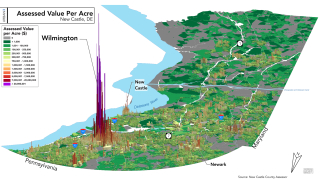
Caption: A small area generates the huge amounts of tax potential in New Castle County. Image attribution to The Urban3

The unavoidable conclusion

This analysis does not claim that every compact project is good or every low-density neighborhood is bad. It does not argue for eliminating choice or forcing uniformity.

It shows something more basic.

If we want fiscally responsible development, we must first make it legal to build it.

Right now, New Castle County’s zoning map does the opposite. It makes productive development the exception and fragile development the norm.

No amount of incentives, planning documents, or rhetoric can overcome that imbalance.

Before asking how to build smarter, the county must confront a simpler question:

What does our zoning actually allow?

This article exists to answer that question with numbers rather than assumptions.

Recent Perspectives

Dec 20th, 2025

What is County Government?

Why things like walkability, housing, open space, and community don't happen by accident. County government quietly creates the systems we live on top of, and w...
Nov 18th, 2025

Affordable Housing Pays the Bills

Compact, efficient neighborhoods, the kinds often labeled as "affordable housing," don't just save money. They are the most fiscally productive parts of our com...
Nov 4th, 2025

Data Centers Shouldn't Cost Us More Than They Give

Without guardrails, data centers leave residents with higher bills, noise, and infrastructure costs. Ordinance 25-101 is a smart step toward balance.

Keep up with Jason’s Campaign